
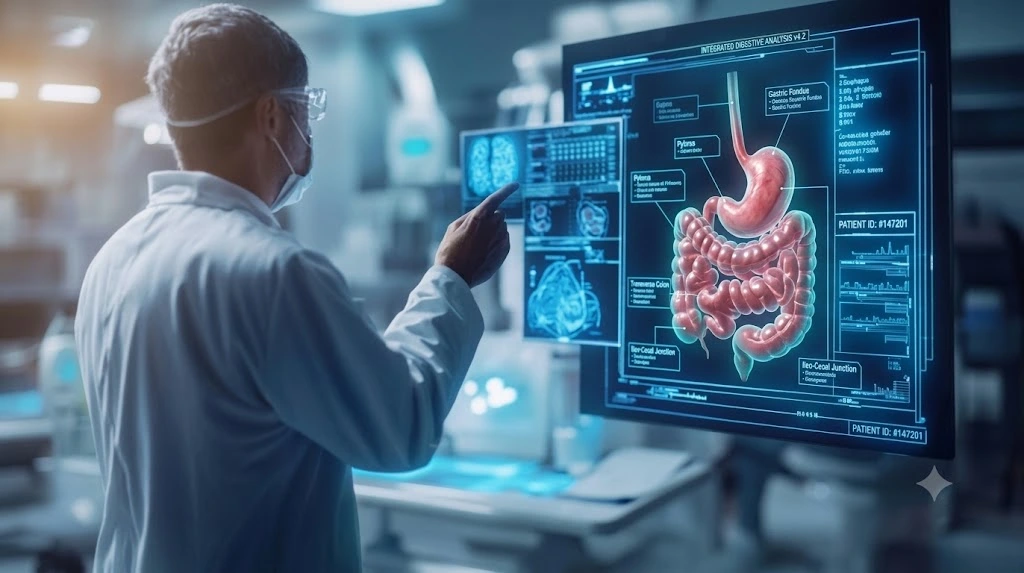
Advances in imaging and artificial intelligence are helping clinicians identify abnormalities and support diagnostic decision-making. But the quality of a colonoscopy depends on more than what an AI system can recognise on screen.
It also depends on how the procedure is performed.
How efficiently can the colonoscope be advanced?
Can the endoscopist maintain orientation?
Has the mucosa been adequately visualised?
These questions point towards a broader opportunity: procedure intelligence.
A procedure, not just an image
Colonoscopy is a dynamic procedure involving a flexible instrument, a changing anatomical environment and continuous decision-making by the endoscopist.
Loop formation can make advancement technically demanding. Navigation through a deformable colon can make orientation difficult. And even a highly capable detection system cannot identify pathology in mucosa that has not been adequately visualised.
This means that improving colonoscopy requires more than better detection.
It requires technology that understands the procedure itself.
Core Scope’s intelligent colonoscopy platform
Core Scope Endoscopy is developing a platform designed around three interconnected areas of the procedure.
Loop Straightener
A single-use mechanical adjunct being developed to help manage recurrent looping and provide additional control during advancement.
Colon Mapping
AI-enabled software being developed to map mucosal visualisation and identify areas that may not have been adequately inspected.
Path Finder
AI-enabled navigation technology being developed to support procedural orientation and direction of travel.
Each technology addresses a different part of the workflow, but together they form a broader proposition.
Hardware + AI
The combination of mechanical control and AI is central to Core Scope’s approach.
The Loop Straightener addresses the physical challenges of colonoscope advancement. Colon Mapping addresses mucosal coverage. Path Finder addresses navigation and orientation.
The aim is to connect these capabilities within an ecosystem that works alongside existing colonoscopy systems.
Importantly, Core Scope’s AI technologies are being developed to complement existing CADe systems, rather than replace them.
Towards a more measurable procedure
Another opportunity lies in procedural measurement.
Today, the quality of a colonoscopy is not defined only by whether a lesion is detected. There is increasing interest in understanding procedural performance more quantitatively.
Core Scope’s developing AI platform is intended to support quantitative assessment of visualisation and, ultimately, procedural performance.
This creates the potential for a future in which colonoscopy is not only visually assisted, but also more measurable and data-informed.
The next generation
The future of colonoscopy may not be defined by a single breakthrough technology.
It may come from bringing together mechanical assistance, navigation, visualisation and AI around the complete procedure.
Core Scope is building towards that vision.
From managing loops, to finding the way, to understanding what has been seen, the focus is shifting from simply detecting abnormalities to making the procedure itself more intelligent.
The future of colonoscopy is not just better detection. It is better procedure intelligence.